Work / Independent AI · Business intelligence for independent restaurants
Disha Analytics
Turns public reviews, menus and competitor data into one report with a ranked action plan, where every claim is linked to its evidence.
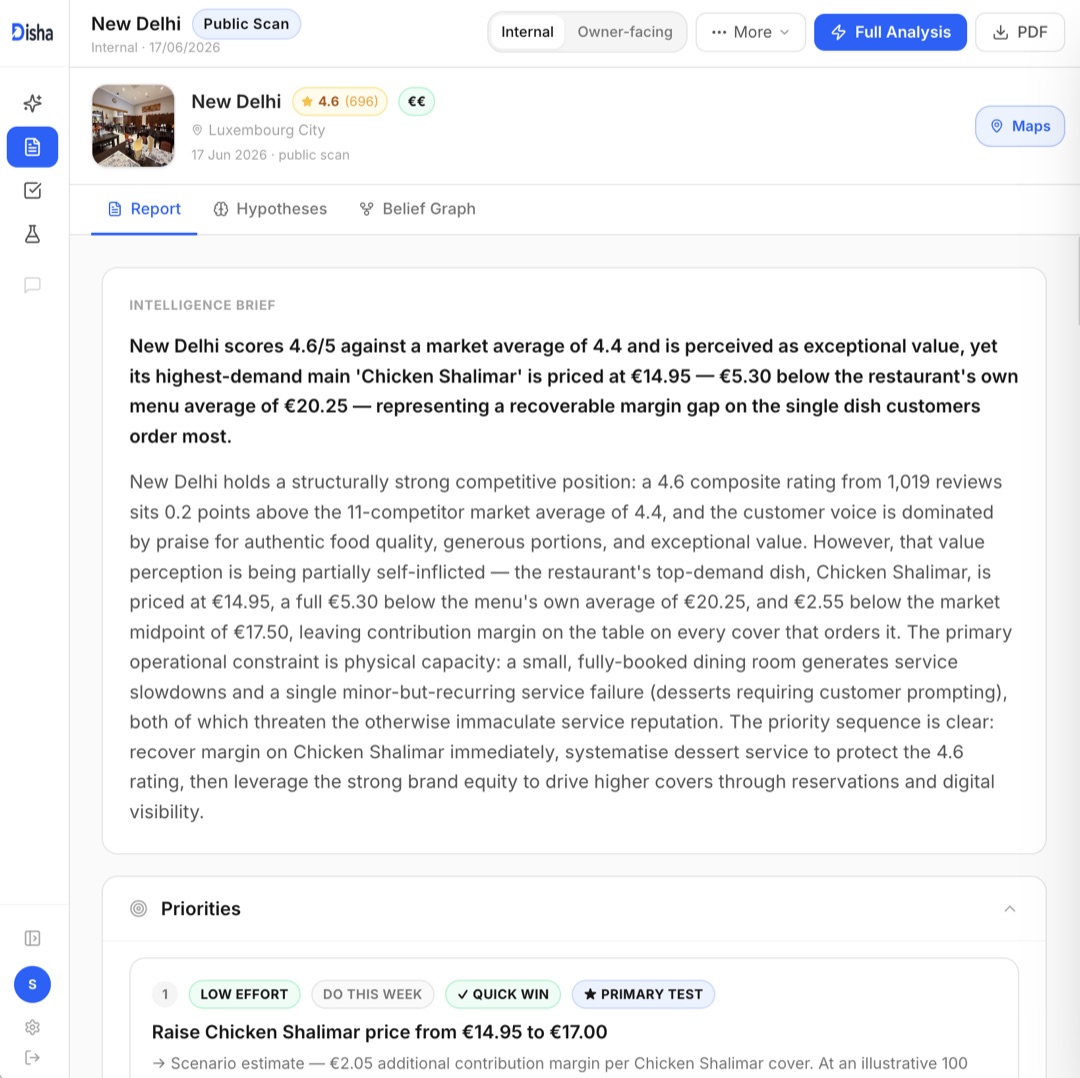
I walked through one pilot report with the owner of a Luxembourg restaurant.
01
Purpose and scope
Independent restaurants can see their reviews, menus and competitors online, but no tool combines that information into a short list of decisions.
Disha takes a restaurant name and city, collects public data, and produces a report with findings, evidence and a short list of ranked actions.
02
What I built
- Collectors for 9 public sources (the restaurant’s own site and menus, Google Places, TripAdvisor, TheFork, Wolt, Yelp and others). Every fact carries its source, time and confidence.
- AI agents analyze reviews, competitors and menus through fixed output schemas. Code computes every percentage and figure; nothing numeric is taken from the model.
- A typed claim ledger: each statement is observed, estimated, inferred, hypothesis or validated, with its evidence and how it would be validated.
- Seven audit rules run after the AI writes the report. An error blocks the owner-facing PDF.
- Django REST API, React console, Celery jobs and PostgreSQL in Docker on a small server, with CI and about 245 tests.
Python · Django REST Framework · PostgreSQL · Celery + Redis · React + Vite · WeasyPrint · Docker · GitHub Actions
03
Architecture and data flow
Name and city go in. Collectors pull public data from 9 sources, agents analyze it through fixed schemas, deterministic code calculates the figures, the claim ledger records every statement, and audit rules check the draft before a report is issued in one of three formats.
Restaurant name + city
optional: owner financials, menu, POS export
9 public data sources collected
Reviews
Menus
Competitors
Maps
Pricing
Financials
AI agents + deterministic checks
Decision-ready report
Ranked action plan
Competitor benchmark
Hypothesis checklist
Three delivery modes
Public Scan
Validated Report
Owner Walkthrough
04
In the product
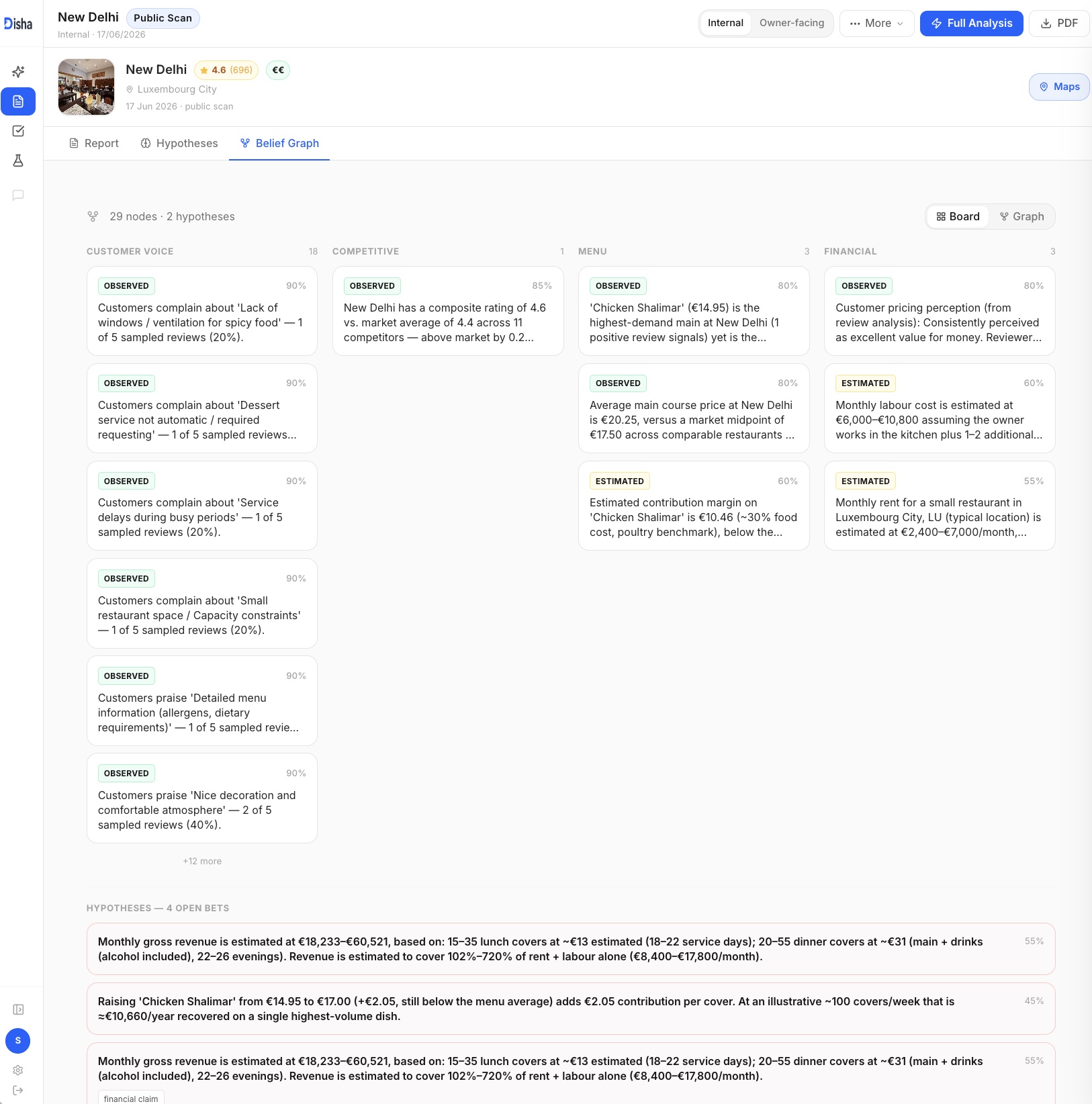
Evidence view: each conclusion linked to its sources
The evidence view for the same report: 29 statements grouped into customer voice, competitors, menu and financials. Each statement is tagged as observed, estimated or hypothesis and carries a confidence score, so a reader can see what the conclusions rest on.
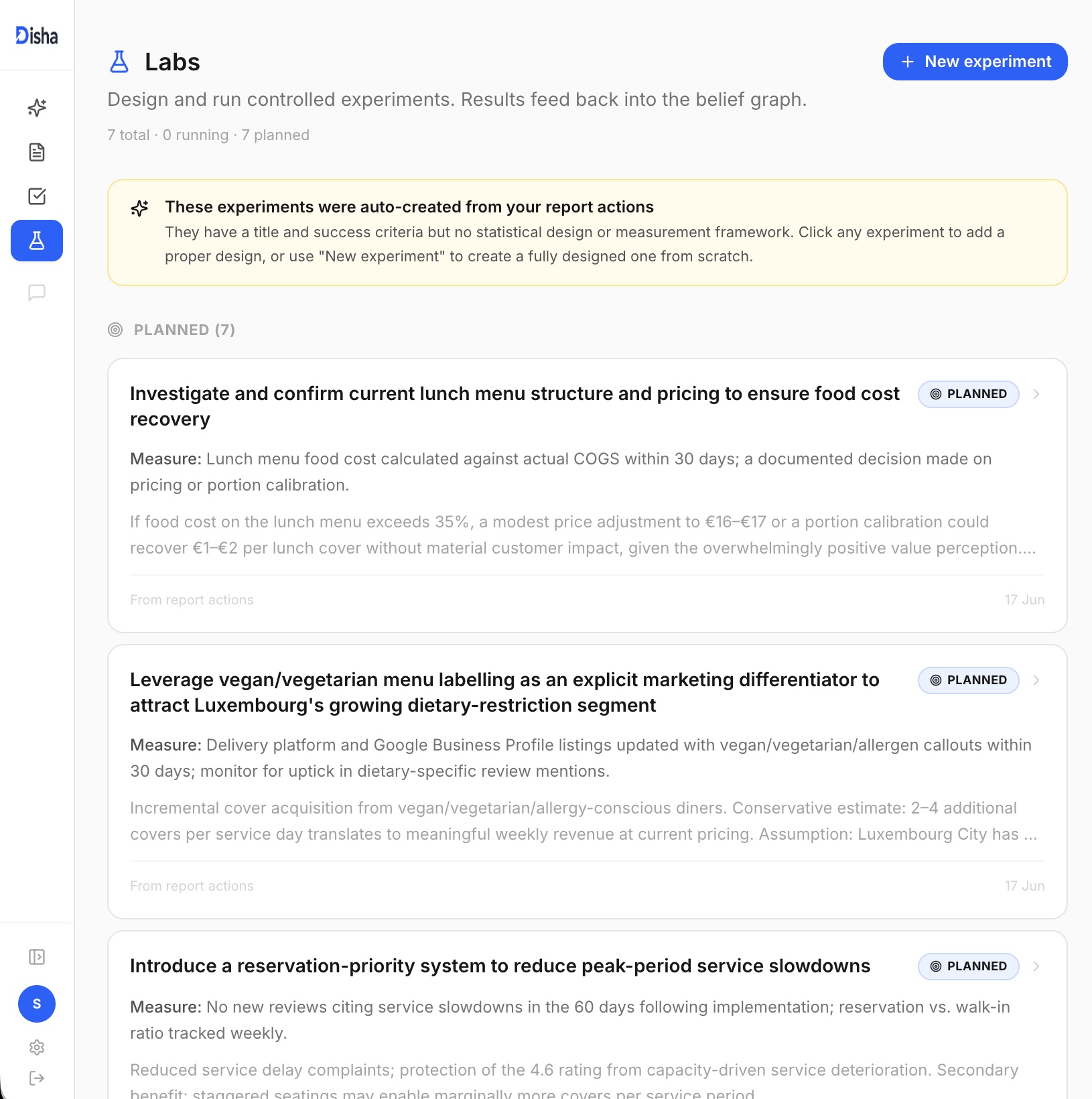
Labs: experiments drafted from the findings, none run yet
Labs turns the report’s actions into seven planned experiments, each with a measure and an expected effect. The screen states that they have no statistical design yet. None has been run.
05
What the prototype demonstrates
- Keeping numbers deterministic while AI does the reading and drafting.
- An audit trail from every sentence in a report back to its evidence.
- A full data product: ingestion, quality checks, API, console and PDF output.
06
Current limits and next steps
Limits today
- No restaurant uses it today. I walked through one pilot report with the owner of a Luxembourg restaurant and evaluated about five restaurants.
- Action ranking is done by the AI today, not by a deterministic score.
- The experiment tools design tests but no experiment has been run.
Next
- An evaluation harness that runs the AI pipeline on simulated restaurants with planted problems.
- Deterministic action ranking and saved data-quality results.
Next project
Soul Spark