Work / Independent AI · Local services marketplace for residential communities in India
CircleWorks
Residents post a job by text or voice. AI parses the request, rules set the price and the risk level, AI explains the price in plain words, and payment goes directly between people by UPI.
Piloted in one Bengaluru residential society with a local operations partner.
01
Purpose and scope
In Indian residential societies, residents hire cooks, cleaners, helpers, tutors and drivers by word of mouth. There is no verified record of who is reliable, no shared price reference and no record of payments or disputes.
Letting a stranger into a home needs trust on both sides. CircleWorks builds that trust from each completed job, and the platform never touches the money: payment goes directly by UPI.
02
What I built
- Job posting by text or voice, with jobs translated into Hindi, Kannada, Marathi and Telugu. AI parses the request, checks validate it, and a rule-based parser takes over if the AI fails.
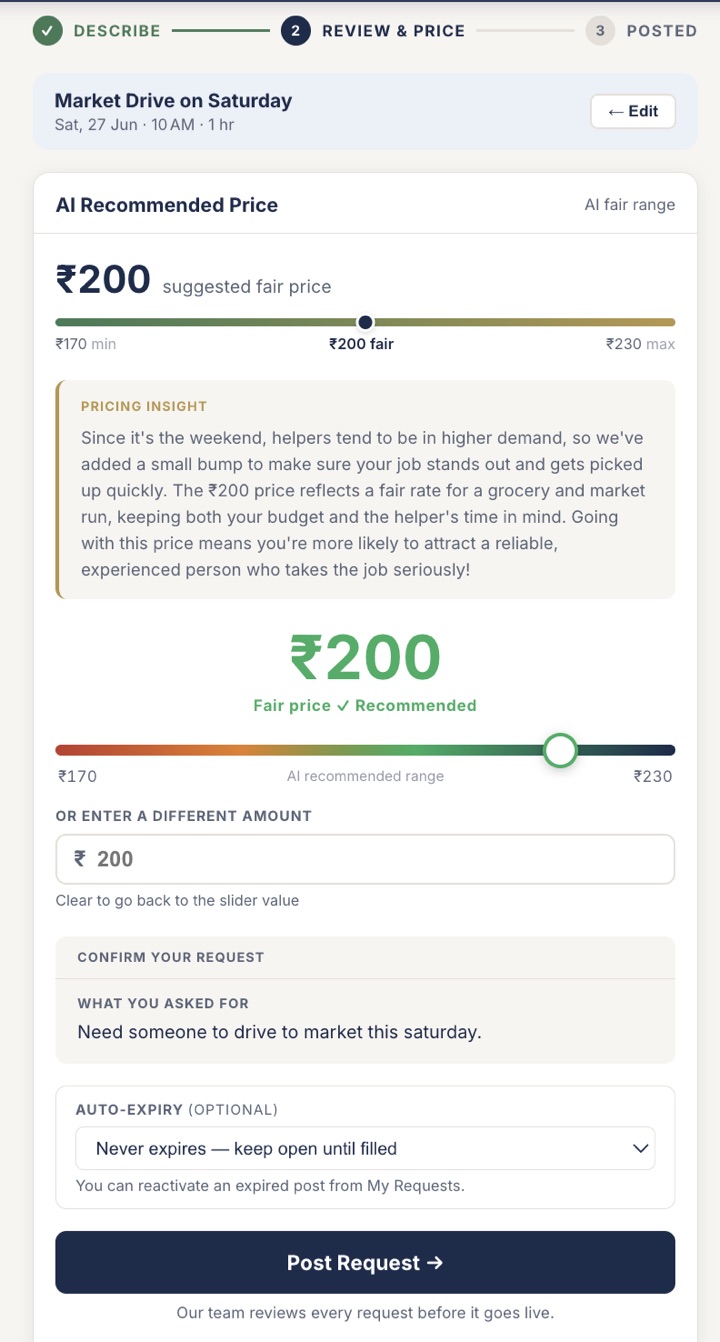
- A rule-based price engine (base rate, duration, headcount, complexity, weekend or urgency, experience) that gives a range of ±15%. AI explains the price in plain words but never sets it.
- Risk tiers set by rules, where anything that enters the home is higher risk, with the advance payment tied to the tier. AI writes only a one-line reason, and an operator can override it with a reason.
- Explainable trust scores for workers (seven parts) and reliability scores for residents, progressive verification that controls which jobs a worker can see, and identity numbers never stored.
- Dispute handling with a playbook for each dispute type, scope cards and change orders, and photo and payment evidence.
- A Telegram bot that serves as both the user channel and the operations console, a pilot metrics dashboard, scheduled digests, and a picture-first redesign for users with low literacy.
Django · PostgreSQL · Telegram Bot API · Anthropic API · OpenAI Whisper · Railway
03
Architecture and data flow
A Django application on Railway with PostgreSQL, four scheduled jobs and a Telegram bot. The AI pipeline follows one rule: AI extracts, code decides, AI explains. A job description goes to the AI parser, price and risk come from rules, and AI writes the explanation. Matching filters workers by verification and skill and ranks them by trust score. Payment never passes through the platform.
Resident posts a job
text or voice · translated into 4 Indian languages
Code decides
Matching
Verified workers apply
verification level gates which jobs they see
Operator or resident picks
ranked by trust score
Payment directly by UPI
the platform never touches money
After each job
Worker trust score
7 explainable parts
Resident reliability score
payment, completion, ratings, disputes
Backend
04
In the product
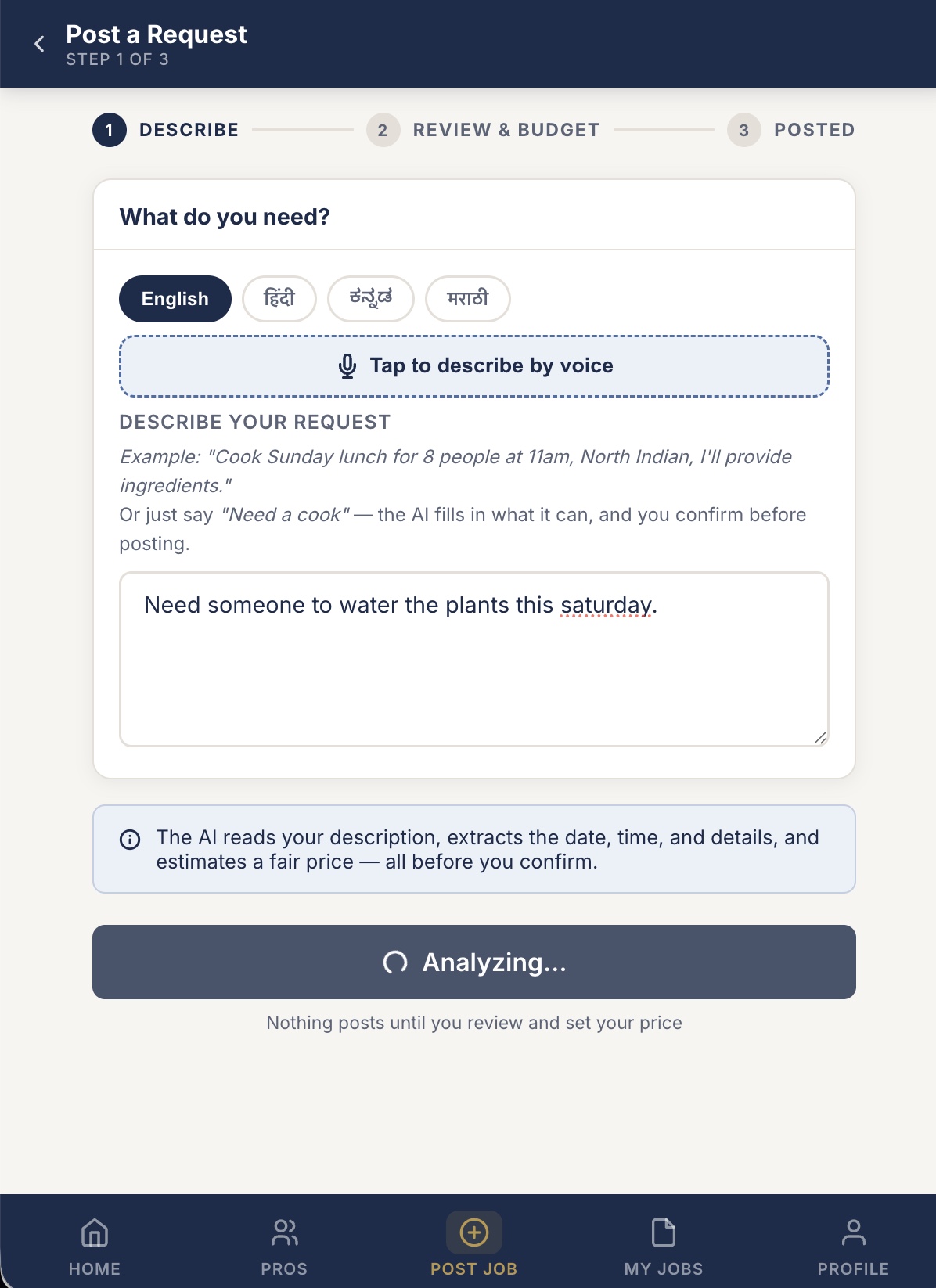
Post a job by text or voice
Step 1 of 3. The resident describes the job by typing or speaking, in English, Hindi, Kannada or Marathi. Nothing is posted until the resident has reviewed the details and set the price.
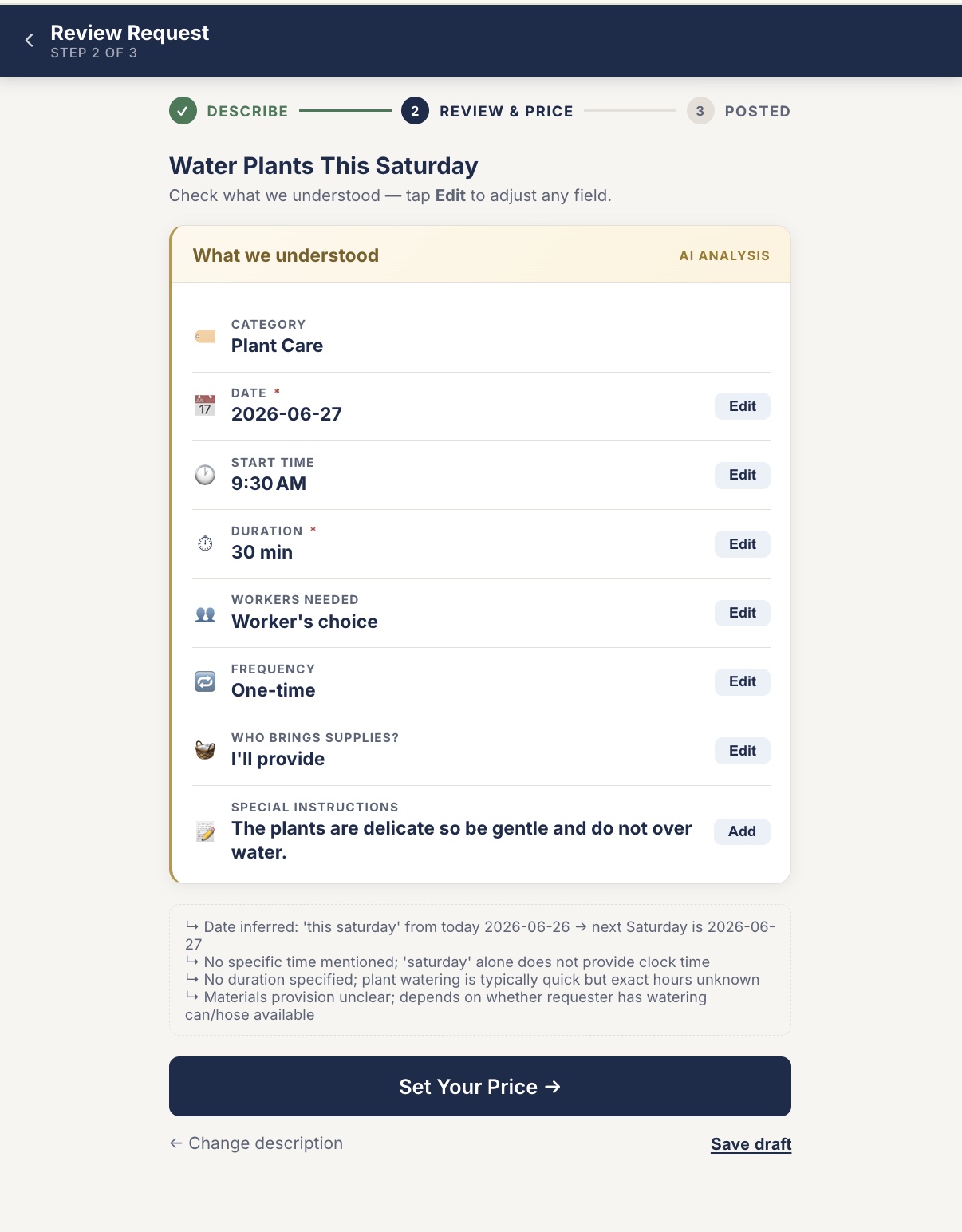
What the AI understood, checked and editable
Step 2. The details the AI extracted from one sentence: category, date, time, duration, number of workers, frequency and supplies. Each field can be edited, and the notes below show how the date was worked out and what was missing.
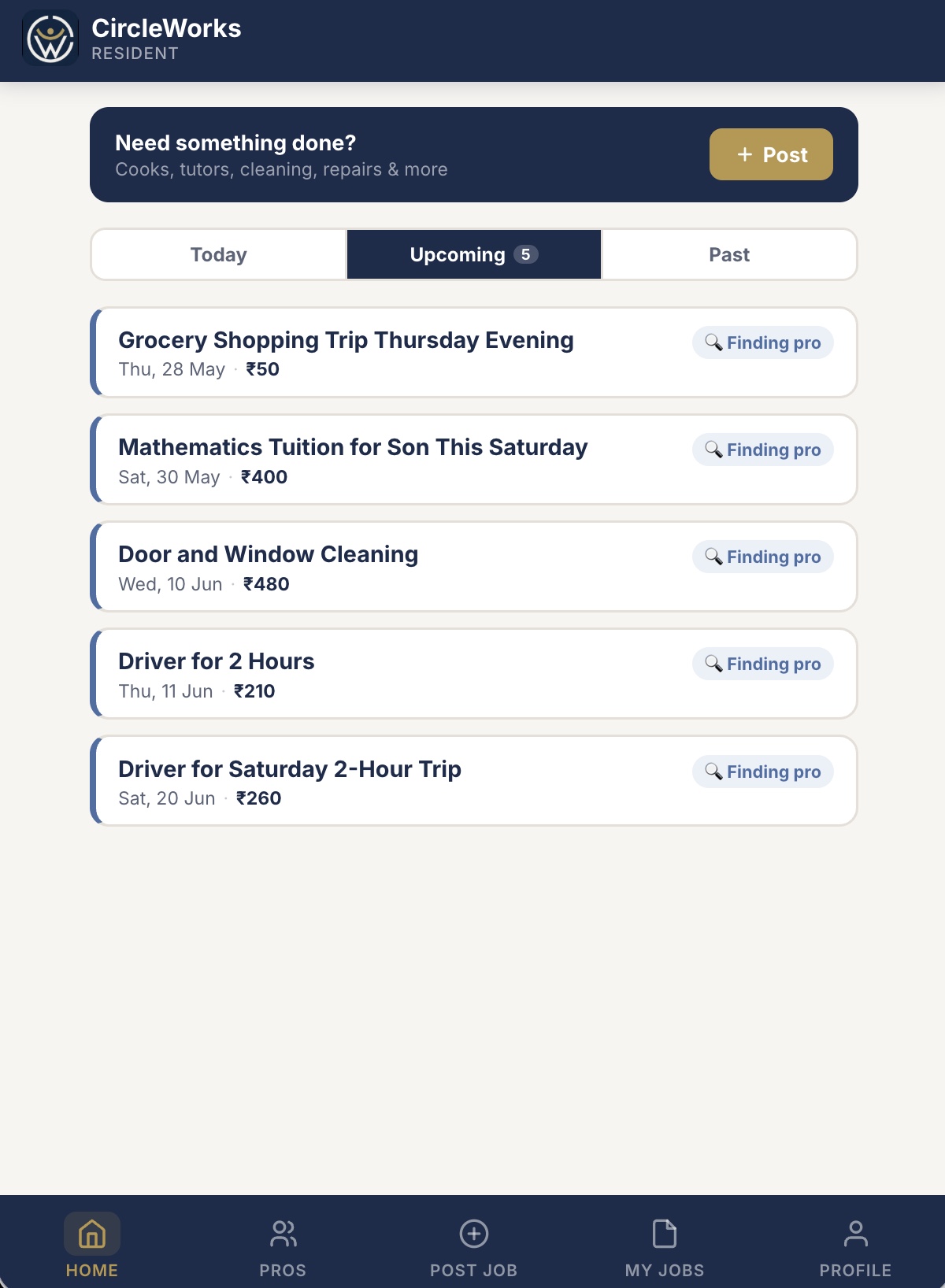
Resident home: upcoming jobs
The resident’s upcoming jobs, each with its date, price and status. "Finding pro" means the job is waiting for a matched worker.
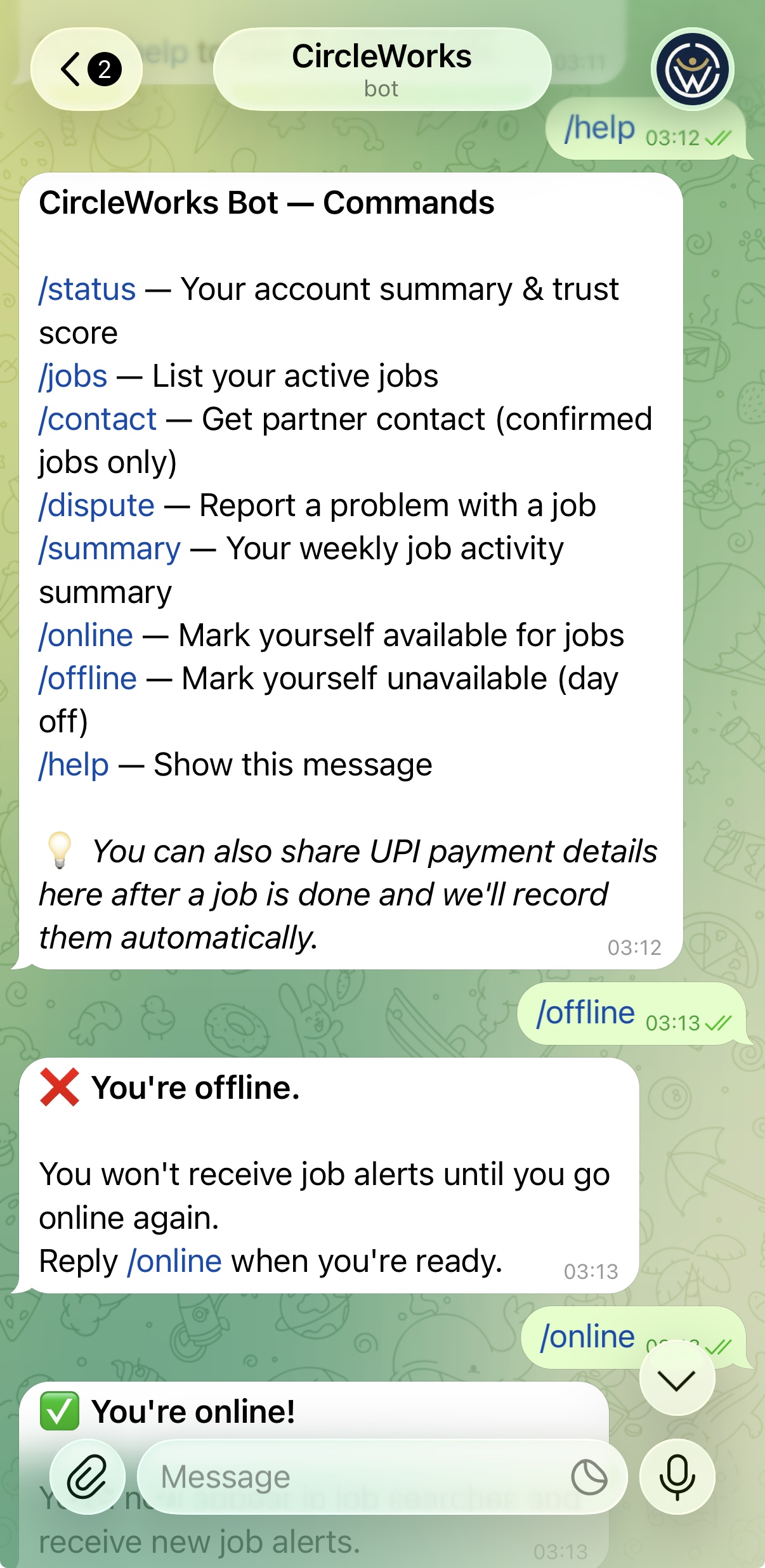
Telegram bot: the worker and operations channel
Workers use Telegram commands to check their trust score and active jobs, report a dispute, and mark themselves available or off for the day. Payment details shared in the chat after a job are recorded.
05
What the prototype demonstrates
- Keeping AI out of decisions that must be explainable, such as price and risk.
- Designing trust and safety in from the first version: verification, disputes, evidence and fraud signals.
- Designing for users with low literacy who speak several languages.
06
Current limits and next steps
Limits today
- One residential society. Pilot volume and outcomes are not yet measured, and there is no revenue.
- No automated tests, and AI calls are not logged or evaluated.
- Matching ranks candidates by trust score only; the designed soft ranking is not built.
- Resident text and voice are processed by US-hosted AI services.
Next
- Unit tests for the price, trust, reliability, risk and parser rules.
- A metric dictionary, data-quality checks and an AI evaluation set of 40 job descriptions.
- Calibrate pricing from agreed prices and backtest the ±15% range.
Next project
Disha Analytics